 Zenith Wellness
VO2 max is the maximum amount of oxygen your body can use during hard exercise. It’s one of the strongest signals of endurance fitness, and one of the best independent predictors of how long and how well you’ll live. Higher VO2 max links to lower mortality, lower heart disease risk, and a longer healthy span.
Your Garmin and other smart watches now estimate it from heart rate and pace or power. The absolute number isn’t lab-grade, but the trend is real and that’s what you can move. Here’s how.
Your VO2 Max Is Personal
There’s no universal “good” number. A trained 25-year-old male might sit at 55 ml/kg/min while a fit 50-year-old woman sits at 38, and both are excellent for their age. Genetics matter too. The HERITAGE Family Study (Bouchard) found that putting identical training programs into different bodies produced wildly different responses, with some people classified as low responders no matter how consistently they trained.
The takeaway: comparing your number to someone else’s doesn’t tell you much. What matters is your own trend. If your 30-day average is climbing, what you’re doing is working.
Fitness
Two pillars do most of the work for VO2 max: a lot of easy training, plus one weekly session near your top end. Almost everything else is a variant of getting that ratio right.
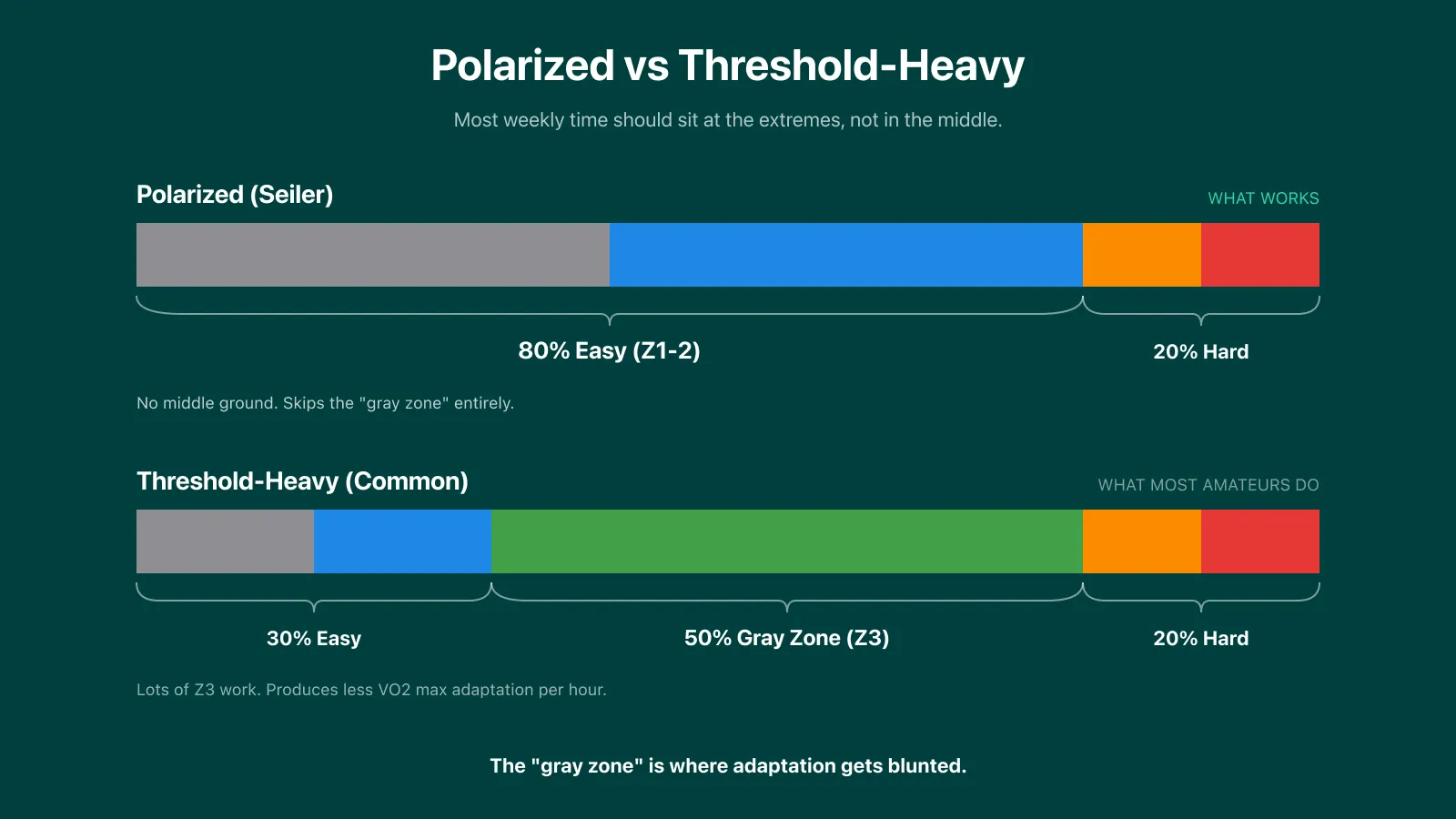
Spend ~80% of your time easy. Elite endurance athletes consistently spend about 80% of training at low intensity (Zones 1-2) and 20% at high intensity (Zones 4-5), with very little time in the middle. Stephen Seiler made this the foundation of polarized training back in 2010, and the framework has held up across every subsequent meta-analysis. The “gray zone” in the middle (Zone 3) feels productive but produces less VO2 max adaptation per hour than time spent at the extremes.
If you don’t know your zones, our heart rate zones guide breaks them down, or just use the defaults already on your Garmin.
Do one true hard session a week. The most replicated VO2 max protocol is the Norwegian 4x4 (Helgerud, 2007): four 4-minute efforts at roughly 90-95% of your max heart rate, with 3 minutes of easy recovery between. At three sessions a week for 8 weeks, this raised VO2 max 7-9% and stroke volume by ~10% in moderately trained subjects. Most amateurs don’t need three of these a week. One, done consistently, is enough to keep the trend moving.
Volume matters too. Higher weekly training time correlates with VO2 max gains, especially for people who aren’t already highly trained. Polarized only works if there’s a real base under it. A workable structure for most people: 4-6 hours of easy training per week with one weekly hard session.
Strength training doesn’t directly raise VO2 max. It supports it indirectly through better running economy, fewer injuries, and more durability under load. Worth doing for those reasons (our strength training guide covers how Zenith tracks it), but it’s not a lever for the metric itself.
Recovery and Lifestyle
The work only counts when your body absorbs it. Most VO2 max plans fail not because the sessions are wrong, but because recovery doesn’t let the adaptations land.
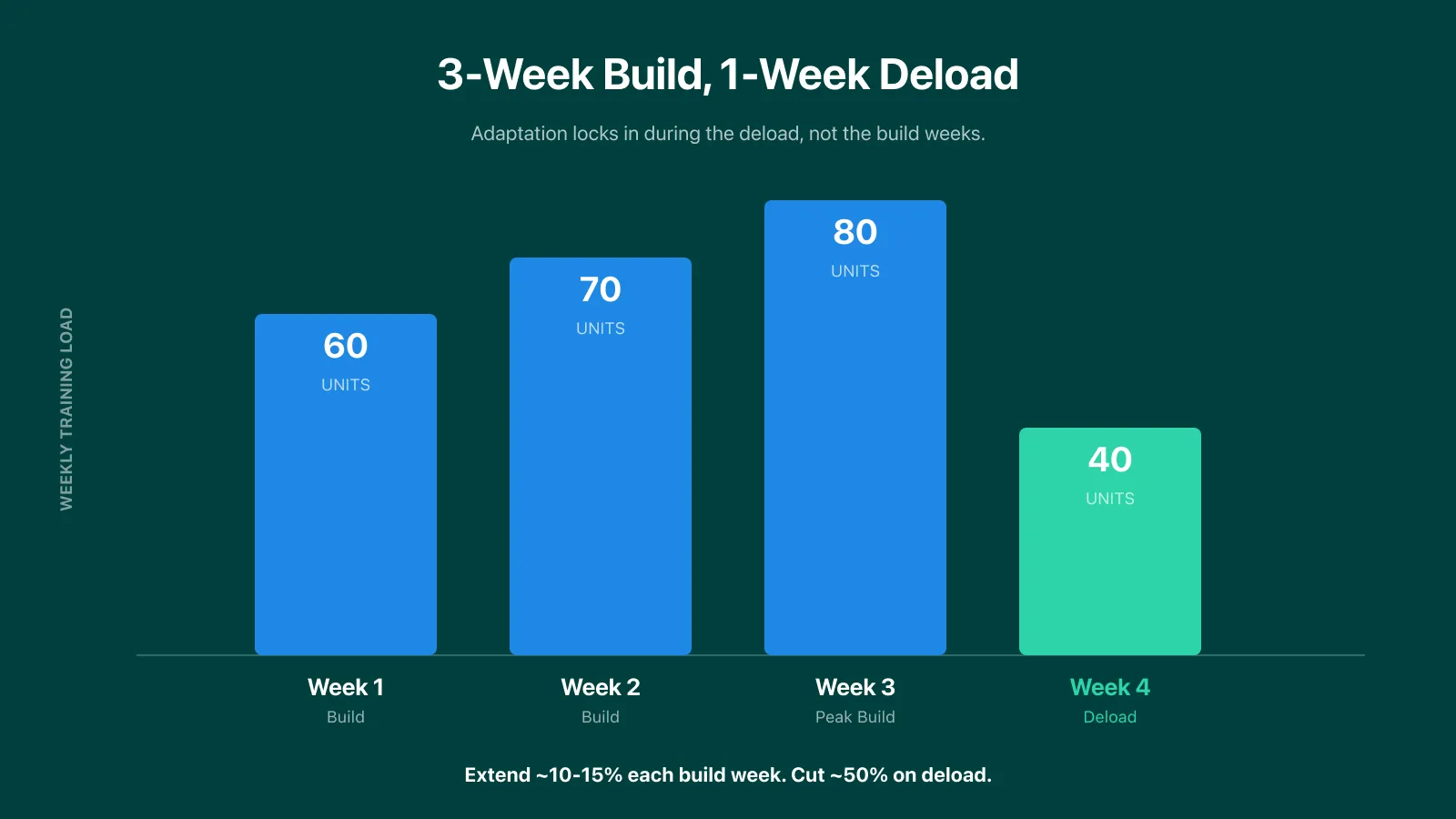
Build for three weeks, deload for one. Pushing volume up too aggressively week over week invites injury and burnout. Nielsen (2014) found that single-week increases above ~30% raised overuse injury risk meaningfully. A practical structure: build for 3 weeks with modest 10-15% increases in volume, then deload for 1 week at roughly 50% of recent volume while keeping intensity. Most of the adaptation actually shows up during the deload week, not during the build.
Sleep. The aerobic and cardiovascular adaptations training is trying to produce (mitochondrial growth, stroke volume, capillary density) get blunted by poor sleep. If your VO2 max trend has flattened despite consistent training, sleep duration is the first thing to audit.
Body composition. VO2 max is normalized to body mass, so losing excess body fat raises the number without any change in oxygen uptake. People who target body composition through sensible caloric balance often see VO2 max climb without changing anything about their training.
Overtraining. If you’re stacking volume and intensity without enough recovery, your VO2 max will plateau or fall. Watch for resting HR creeping up, HRV trending down, and motivation dropping. Those are the same signals that show up before performance drops, so they’re worth tracking.
What Doesn’t Work as Well as You’d Think
Threshold-heavy training. A lot of amateurs spend most of their week at moderate intensity (Zone 3, tempo pace), assuming it builds VO2 max efficiently. Studies have consistently found this approach delivers less than a polarized distribution does. Rosenblat (2019) meta-analyzed the comparison and confirmed polarized came out ahead across endurance markers. The “gray zone” feels like hard work, but it doesn’t push your top end the way true high-intensity work does.
Zone 2 alone. Low-intensity base does important work, but a 2025 review in Sports Medicine pushed back on the popular claim that Zone 2 is uniquely optimal for mitochondrial adaptation. VO2 max specifically requires stimulus near VO2 max (Buchheit & Laursen). Zone 2 builds the engine block. Intervals raise the redline. You need both.
Chasing a single absolute number. A daily VO2 max reading on a watch is noisy. A bad workout or a few days off can move the estimate by 1-2 points without any real change in fitness. The signal is in the 30-day and 90-day trend, not any single reading.
How Long It Takes
- 4-6 weeks for the first measurable changes. Stroke volume and oxygen extraction adapt fastest.
- 3-6 months for most of the available adaptation in moderately trained adults. This is where the bulk of the gain shows up.
- 6-12 months to push toward your personal trainability ceiling. After that, gains slow noticeably.
Expect a noisy line. A 14-day average that’s trending up is the signal. A single morning reading isn’t.
Tracking It
Your Garmin already estimates VO2 max from your training. Zenith plots it alongside your heart rate zone distribution, longest weekly session, and resting heart rate so you can see whether your block is delivering the adaptation you’re working for. The 30-day and 90-day rolling averages cut through the daily noise.
Want to track your VO2 max trend? Try Zenith. It’s free to start.