 Zenith Wellness
If you lift and wear a Garmin, your watch records the workout, but the number it hands back never quite captures how hard the session was. A heavy day of squats can look quiet next to an easy jog. The right app fixes that.
Quick answer: For lifters who own a Garmin, Zenith is the best free way to turn strength workouts into real analysis, including muscular strain, tonnage, 1RM estimates, and muscle heatmaps, all folded into one strain score alongside your cardio. Garmin Connect logs the sets, and dedicated apps like Strong track your lifts, but neither reads the physiological load the way Zenith does.
What does Garmin Connect do for strength workouts?
Garmin Connect records strength sessions with reps and sets, and newer watches auto-detect some exercises. It is a solid log. Where it stops is interpretation: how much load you moved, how that trends over a training block, and how a hard lifting day fits your recovery. How Zenith compares to Garmin Connect covers that gap.
Why recovery wearables miss lifting
This is the real problem for lifters. WHOOP and Oura build their strain and recovery mostly from heart rate. A heavy set of deadlifts spikes muscular load but barely moves your average heart rate, so those devices score it as an easy day even though you will feel it for the next two. Zenith vs WHOOP goes into this. Zenith instead calculates muscular strain from the weight and reps you lifted, so strength training counts for what it is.
What a strength app should give a Garmin owner
A strength-aware app reads the same workout and surfaces the parts that shape training:
- Muscular strain folded into your unified strain, so lifting and cardio live on one scale.
- Tonnage and volume trends across weeks, so you can see whether you are progressing.
- 1RM estimates from your working sets.
- Strength analytics including intensity zones that map your weight to how hard the muscle is working.
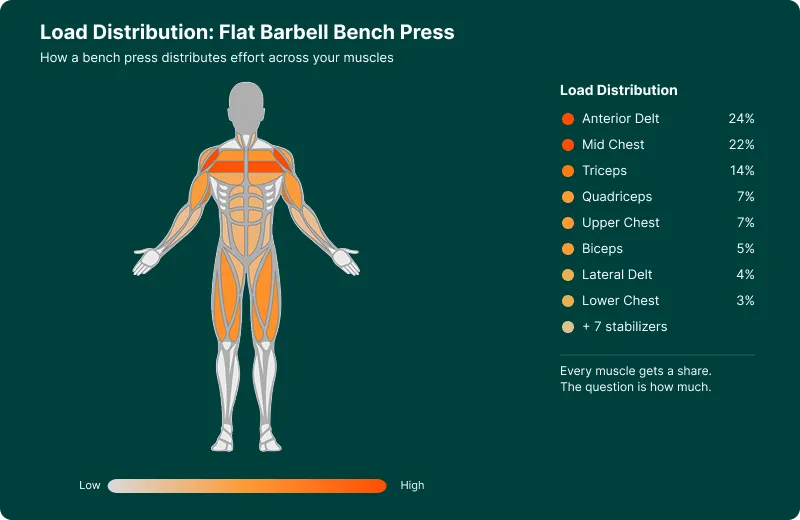
The muscle heatmap is the part lifters tend to notice first. It shows which groups a session loaded, so you can spot what you have been skipping across a week.
The best apps for Garmin-owning lifters
Zenith
Zenith is where you log your training, and it turns your lifting into muscular load and strain, tonnage, 1RM estimates, and muscle heatmaps, then ties it to your recovery and folds it into a single strain score with your cardio, the connection Garmin itself does not make. It is free at its core, with an optional Pro tier for full history. For a Garmin owner who lifts, nothing else logs your training and ties it to your recovery the same way. Try Zenith. It’s free to start.
Garmin Connect
The base layer you already have. Keep it for recording sets and reps, and add one app on top for the load and recovery context it does not calculate.
Strong or Hevy
Dedicated lifting logs like Strong and Hevy are excellent for planning workouts and tracking your lifts set by set. They do not read your Garmin physiology or fold strength into a recovery picture, so they solve a different problem than Zenith does. For how each one handles Garmin sync, see do Strong and Hevy work with Garmin, and for the popular one specifically, does Hevy work with Garmin.
WHOOP or Oura
Good recovery devices, but cardio-biased. They undercount lifting and require their own hardware and subscription. If strength is a real part of your training, they leave the biggest piece out.
How to choose
- Own a Garmin and want your lifting to count toward strain and recovery: start with Zenith.
- Want a dedicated log to plan and record sets: Strong or Hevy, ideally alongside Zenith.
- Mostly train cardio and lift occasionally: a recovery wearable may be enough.
Your Garmin already records the session. The best strength app is the one that reads it and shows you the load your muscles carried.
For the wider view across recovery, sleep, and cardio, see The Best App for Your Garmin in 2026.