 Zenith Wellness
If you lift and own a Garmin, you have probably hit the wall: the best-loved lifting apps don’t talk to your watch. Here is how the popular ones handle Garmin, and what to use instead.
Quick answer: Strong and Hevy are excellent lifting logs, but neither syncs with Garmin. Hevy has said Garmin declined an official integration for now, and Strong only exports to Apple Health and Google Fit. So on a Garmin, those apps sit in a silo away from your watch data. Zenith is different: you log your training in it, and it turns your lifting into muscular load, strain, and a recovery cost, tied to the rest of your Garmin data. That last part matters, because Garmin itself records your lifts but does not count them toward your recovery.
The problem: your lifting app and your watch don’t talk
The popular strength apps were built to plan and log lifts, not to read a Garmin. That is fine until you own a Garmin and want one picture of your training. Then the gap shows.
Garmin keeps its data pipeline mostly closed. It grants write access to only a small set of partners, which is why so few lifting apps can push workouts into Garmin Connect. The result is two separate records: your lifts in one app, everything else on your wrist.
How the popular strength apps handle Garmin
Strong
Strong is one of the cleanest lifting logs there is, and a favorite for tracking sets, reps, and progress. For a Garmin owner the catch is sync: Strong exports to Apple Health and Google Fit, not Garmin Connect. Your Strong history stays in Strong, separate from the watch that tracks the rest of your training.
Hevy
Hevy is a strong free logger with good programming features. But on Garmin it hits a wall Hevy has been open about: Garmin declined an official integration for now, telling Hevy they are too small and to check back later, so Hevy cannot sync workouts to Garmin Connect. People rig up unofficial scripts to force it, which need Hevy Pro and a fair bit of setup, but there is no native integration. For the full breakdown, see does Hevy work with Garmin.
Fitbod
Fitbod is known for AI-driven workout programming that adapts to your recovery. It is a capable planner, and like the others it does not integrate with Garmin, so its suggestions run on its own data rather than what your watch sees.
LiftTrack
Worth naming because it is the exception: LiftTrack is built around Garmin. It can send a routine to your watch and sync the results back. If a Garmin-integrated logger is exactly what you want, it is the one designed for that job.
The distinction that matters: logging vs understanding your load
Here is the piece most of these comparisons miss. Strong, Hevy, and Fitbod are loggers. You type in your sets, and they store and program your lifts. That is only half the job. None of them tell you how a session taxed your body or how it fits your recovery.
Even Garmin falls short here. Your watch records your strength workouts, but it does not treat lifting the way it treats a run: a hard bench day barely moves your Body Battery or training readiness. In other words, Garmin does not really account for weightlifting in your recovery. So the question for a Garmin owner is not only where you log your lifts, it is what turns them into muscular load and ties them to how recovered you are.
Where Zenith fits, and why it is the clear choice for Garmin owners
Zenith is where you log your training, and it lives inside all of your Garmin data, so your lifting is not stuck in a silo and it is not ignored by your watch. It is a logger, but not only a logger. It turns each session into the physiological picture that both the loggers and Garmin itself leave out:
- Muscular load and strain folded into your unified strain, so lifting and cardio sit on one scale.
- A recovery cost for your lifting, so a hard session lowers your readiness the way a hard run does, the tie Garmin never makes.
- Tonnage and volume trends across weeks, so you can see real progression.
- 1RM estimates from your working sets.
- Strength analytics including intensity zones and an anatomical muscle heatmap.
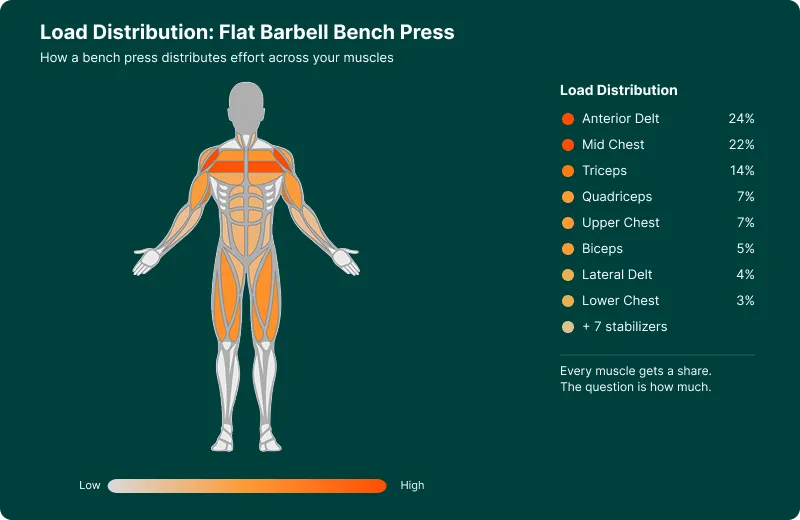
There is no silo, no rejected API, no workaround script. For a Garmin owner who wants their lifting logged, visualized as muscular load and strain, and tied to their recovery, Zenith is the option built for exactly that. It is free at its core, with an optional Pro tier for full history. Try Zenith. It’s free to start.
How to choose
- Want your lifting logged, visualized as muscular load and strain, and tied to your recovery: Zenith, the one that does what neither a logger nor Garmin itself does.
- Want a dedicated app to plan and log lifts set by set: Strong or Hevy, ideally alongside Zenith.
- Want a Garmin-integrated logger that pushes routines to your watch: LiftTrack.
- Want AI-built programming and don’t mind a separate silo: Fitbod.
Most of these apps solve logging. Only one reads what your Garmin already knows about your lifting. For the wider view across recovery, sleep, and cardio, see the best Garmin app for strength training and The Best App for Your Garmin in 2026.