 Zenith Wellness
What an Everest marathon attempt, helicopter rescue and HAPE diagnosis taught me about knowing when to stop.
By Laura K. Soerensen
The hill before me rose only 200 metres, if not less. After trekking for nearly two weeks in the Himalayas—from Lukla Airport all the way to Everest Base Camp—it should have felt insignificant. I had already descended from 5,364 metres to roughly 3,700 metres, meaning all the additional oxygen should have made me feel as though I was flying. It was somewhere around halfway through my marathon attempt, and this was far from the largest climb I had faced, but for some odd reason, I could barely move.
My steps were tiny; I stopped to sit down. Then I stood up, took a few more and stopped once again. Every breath felt inadequate, as though my lungs could not keep up no matter how desperately I gasped for air. I moved towards the top in a way that resembled more of a crawl than a run, feeling less fit than I ever had in my life. Seriously, where had all my fitness gone?
None of it made sense to the version of me I had brought to the mountain; I was an ultra-runner, an Ironman athlete and a somewhat experienced mountaineer. This was nowhere near my first time at altitude, nor was it anywhere near my first attempt at a marathon. I had trained for this, and I knew exactly how to keep moving when everything hurt—I had built much of my identity around doing exactly that.
So, of course, I kept going. Running downhill felt better, and I allowed the temporary relief to falsely reassure me that everything was okay. Then another, much larger hill followed, though still something I would have considered insignificant just a week ago. Partway up, my body made the decision I had refused to make for myself; I lost consciousness.
The next thing I can clearly recall is lying in a mountain hospital, oxygen being delivered to my lungs, whilst waiting for the helicopter to evacuate me to Kathmandu. My lungs had been filled with fluid, and I was diagnosed with high-altitude pulmonary oedema, also known as HAPE. At the time, it felt as though my body had given out without warning, though looking back at the week before the attempt, this is not what happened at all. The warning signs were there, but the problem was that I trusted the athlete I believed myself to be more than I trusted the body that was standing on the mountain that specific day.
Fitness does not equal immunity
Before arriving in Nepal, on January 3rd, 2026, I had every reason to believe I was fit enough for the challenge that waited ahead. As mentioned, I was an Ironman athlete, an experienced ultra-runner, a mountaineer and more than used to taking on difficult terrain and logging long days. Just a month prior, I had completed a 2,300-kilometre gravel cycle across New Zealand in just 15 days, and the month prior to that I had run 63 kilometres on the Greenlandic ice sheet. For the past three years of my twenty years of living, I had built a body that was very good at continuing, but somewhere along the way, I had begun to treat that ability as evidence that continuing was always the correct decision.
We tend to talk about fitness as though it is a permanent ability; someone is either fit or unfit; there is rarely an in between, and it surely does not change within a matter of days. In reality, fitness only describes what your body is capable of doing under specific conditions—change those conditions, and you’ll realise that all your old reference points completely lose their meaning.
Everything changes at altitude
At sea level, I know my body well. I know what different paces should feel like; I know how my heart rate should respond; I know what kind of pain is temporary, and I know what kind of pain indicates an injury. Years of hard training had taught me that pain does not always mean stopping; sometimes it simply means a rest, drinking something or taking another gel.
But at Everest Base Camp, sitting at 5,364 metres, the oxygen level drops to approximately half of what you would experience at sea level. As elevation rises, every breath supplies the body with less oxygen. Acclimatisation is the process through which the body slowly adapts to the lower level of oxygen. It is important to understand that acclimatisation is not a certificate that is rewarded after spending a certain number of days in the mountains. Everyone responds and adapts differently, and factors such as rate of ascent and sleep matter much more than sea level fitness.
I had spent nearly two weeks at altitude on the day I attempted a self-supported version of the Everest Marathon. The assumption that I must have acclimatised after spending so many days at altitude mattered much more to me than the evidence and data suggesting otherwise.
The data was telling a different story
Looking back at my data, the problem did not magically occur when I collapsed; rather, it had been developing for several days.
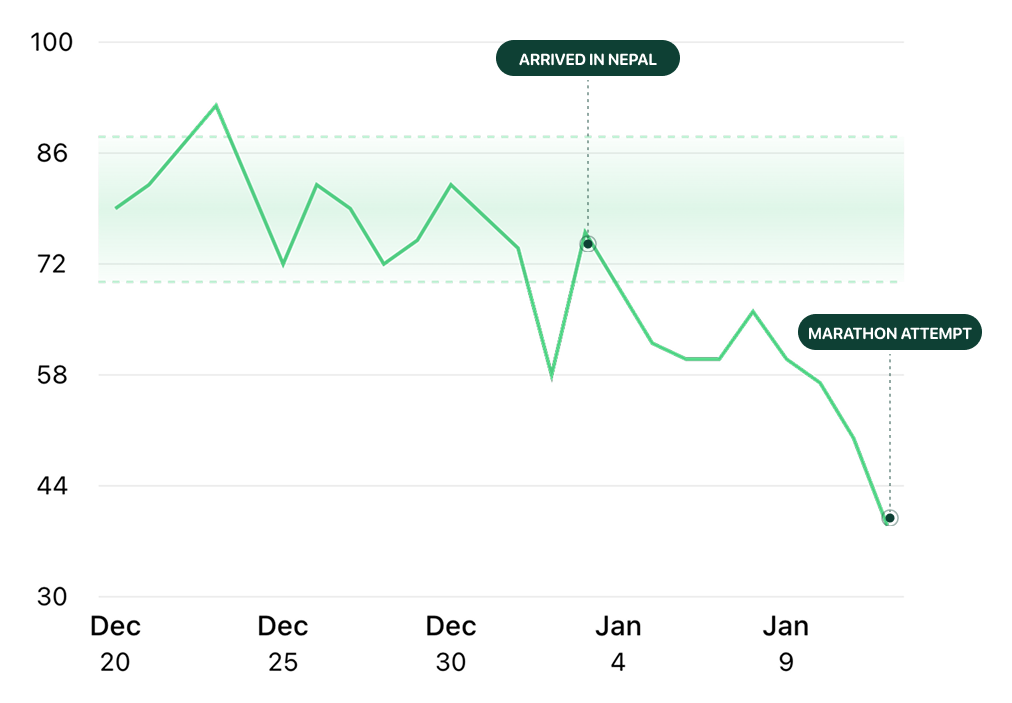
My normal HRV baseline at the time sat between approximately 70 and 89 milliseconds. During the five days leading up to January 14th, my readings had gradually declined from 64, all the way down to 39 milliseconds. An HRV reading is a personal metric. A reading of 39 is not inherently good or bad; it could be entirely normal for a large number of people. What matters is the relationship with the baseline measurement.
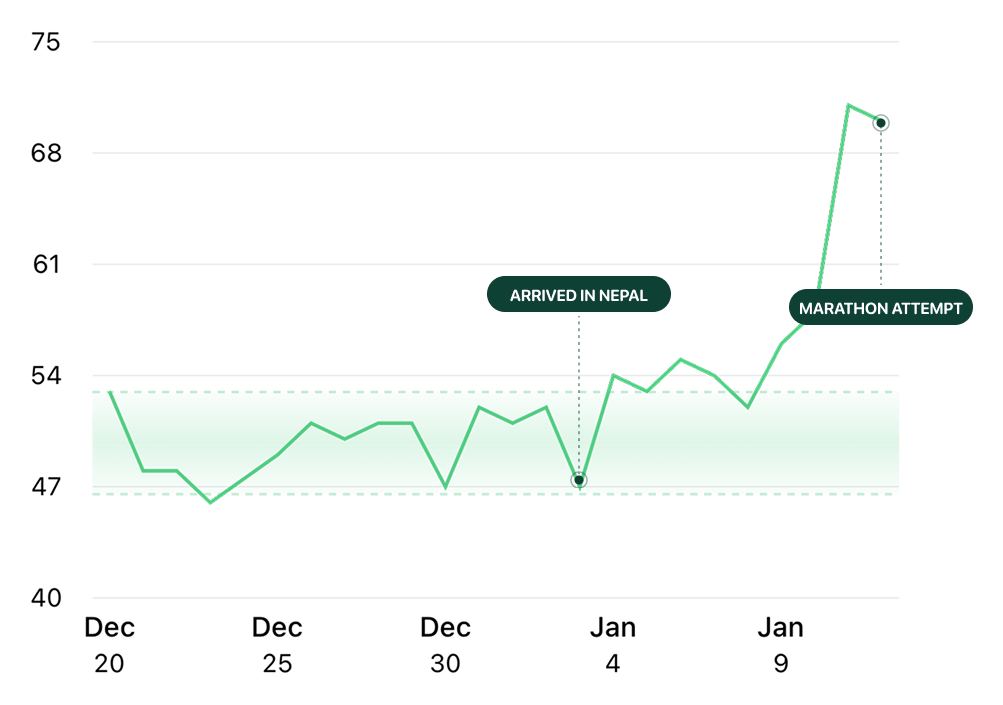
My resting heart rate told a similar story. It rose from its usual level in the high 40s to more than 70 beats per minute during my two final nights of sleep before the attempt. Before I had even started running, my cardiovascular system was working well beyond what it was used to.
Then there were my blood oxygen levels. My Garmin’s wrist-based Pulse Ox estimation had been steadily declining as I had been climbing, though due to the uncertain nature of a blood oxygen wrist measurement, I was also checking with a separate finger pulse oximeter. The two devices measured similar values, though two days before the attempt, the finger measurement had fallen as low as 64%, which should have been a concerning warning sign on its own. It later climbed slightly, showing 76% on the day of running.
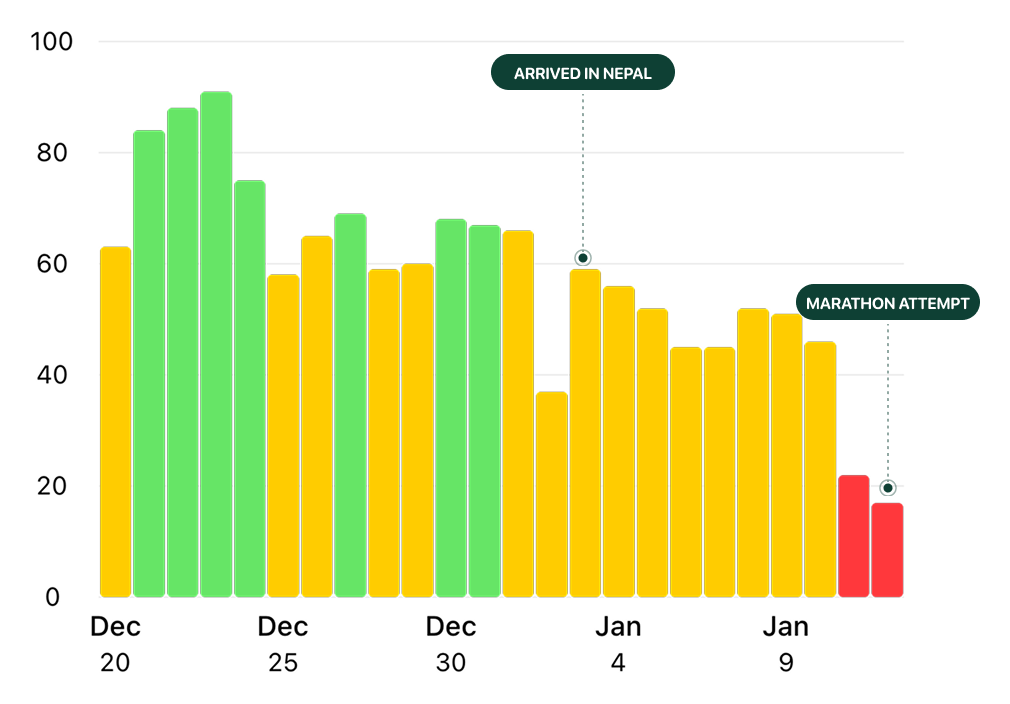
Perhaps, individually, each metric could have been explained, but together they showed a trend that was becoming difficult to excuse, yet somehow, I still managed to do exactly that.
Had I travelled too far to stop?
The night leading up to January 14th, I had barely slept. I was awake for the majority of it, coughing through a sore throat and attempting to breathe through a stuffed nose. A few minutes past two in the morning, I vomited.
By any reasonable standard, this should have ended the discussion about whether I was running or not. Instead, my mind began negotiating. First off, I had travelled all the way to Nepal. I had trekked all the way from Lukla to Everest Base Camp. I had trained for the distance, and I had told people what I intended to do. The event had already consumed so much time, money, effort and emotion that it felt impossible to withdraw on the final morning. Telling myself that I had travelled too far to quit sounded like a decent reason to continue, but in reality, it only explained why quitting felt so painful.
When the morning arrived, I felt horrible, but I got dressed either way and forced down a piece of toast before leaving Gorak Shep in the cold; a decision that should have felt reckless but at the time it only felt determined. That is what makes this kind of thinking dangerous. I never felt as though I was ignoring an emergency; rather, I believed I was refusing to let slight discomfort take away something I had worked so hard for.
When Mental Toughness Becomes Dangerous
The idea of mental toughness is more often than not presented as an uncomplicated strength. Athletes are praised for continuing beyond a point where most people would stop. We admire their ability to tolerate pain, to stay disciplined, to suppress doubt and to remain committed even when the world seems to be working against them. The ability to do those things had helped me through countless races.
But mental toughness is only useful when the objective remains intact. There is a difference between the discomfort of doing something difficult and the deterioration that comes from doing something straight up dangerous. The problem is that in the moment, they do not always feel completely different, and especially not to someone who has trained themselves to interpret suffering as a part of the process.
When each breath felt like a stab in my chest, I adjusted my pace. When I needed to take a seat on a rock within the first five minutes, I deemed it a difficult start that would gradually become easier as I descended. When the climbs became overwhelming, I questioned my level of fitness rather than the safety of proceeding. Every warning simply seemed like an obstacle.
Real resilience does not mean continuing under every circumstance. Real resilience includes the ability to reevaluate when the conditions change. Otherwise, resilience, determination, and persistence all stop serving the goal and begin to serve the ego instead. Sometimes, yes, the bravest decision is to continue—but other times, it is to accept that the version of success you had planned is no longer available. Back then, I did not yet know how to tell the difference.
Listen to Your Body, Not Your Ego
For a long time, I viewed quitting as the opposite of mental toughness. I no longer think that the distinction is that simple. Refusing to stop can many times require a lot of courage, but so can accepting that the conditions have changed. It is much easier to follow a plan than it is to abandon said plan after investing so much effort in completing it.
My mistake was never that I had believed in my level of fitness. I know I had trained hard, and I know I was fit. My mistake was assuming that fitness existed independently of context. The very same body can be fully capable in one environment and dangerously compromised in another. A pace that feels comfortable one week can easily become impossible the next. Previous experience does not grant instant immunity from illness, altitude, or exhaustion.
The lesson I have learned is not to become scared of every unusual metric. The lesson is to pay attention when the evidence begins to agree with how you deep down know you are feeling. When the data starts moving away from its baseline, your symptoms are worsening, and the environment carries serious risk, determination should not be the only voice involved in the final decision.
The mountain did not care how hard I had trained, how far I had travelled or how badly I wanted to finish. It only cared about the body standing there that day. Listening to my body would not have compromised my mental toughness or determination on that day. Perhaps quitting would have been the most determined decision of all.