 Zenith Wellness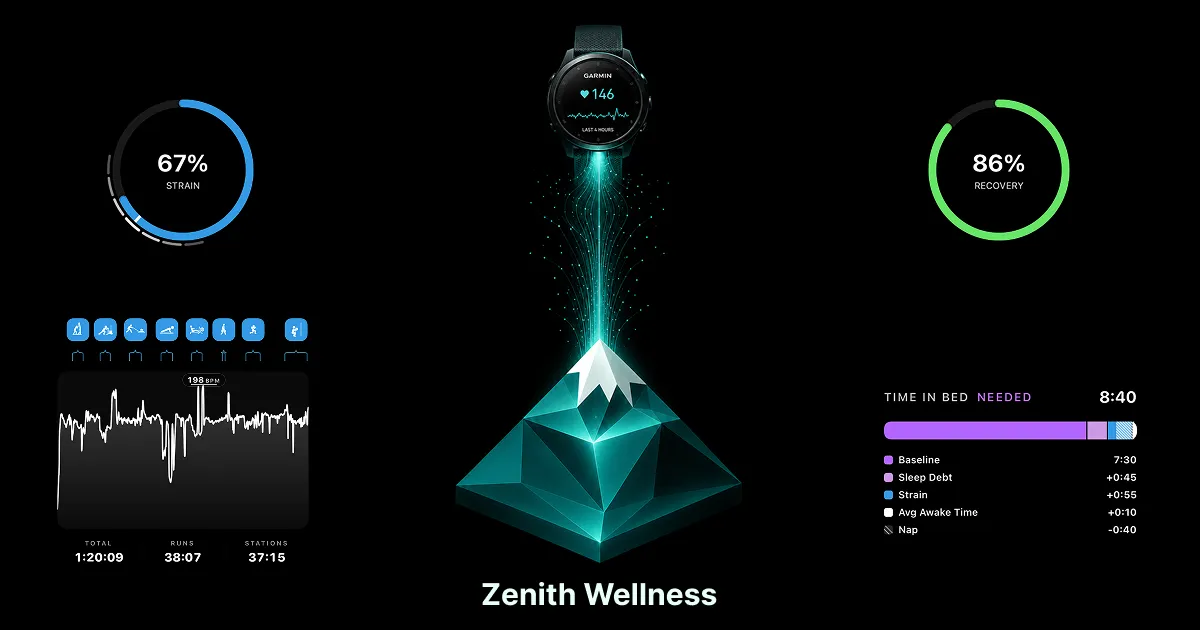
Your Garmin tracks your heart rate every second, your HRV overnight, your sleep stages, and your pace and power on every workout. Then you open the app and get a wall of numbers, a few scores, and little sense of what any of it means for your training. The data is all there. The understanding is left to you.
Quick answer: Garmin records an enormous amount and gives you a handful of scores, but it does little to show how your numbers trend or connect. Pointing an AI at that data does not close the gap, because AI can only see the numbers, not the life that produced them. What helps is a clear, transparent read of your trends that you connect to what is going on in your life.
What Garmin gives you, and where it stops
Garmin is very good at collecting. Your watch captures heart rate, heart rate variability, sleep, stress, pace, cadence, and, if you have the sensors, power. Garmin Connect stores all of it and gives you summaries plus a few scores: Body Battery, Training Readiness, a VO2 max estimate.
Those scores are backed by real algorithms. The gap is not that they are wrong, it is that the app hands them to you and stops. It rarely shows how they move over weeks, how they relate to each other, or what to do next. How Zenith compares to Garmin Connect breaks it down feature by feature. Even the readouts it does surface, like Body Battery or recovery time, leave you deciding what they mean for today. The watch holds everything and leaves the interpreting to you.
Why pointing AI at your data does not work
The common next step is to paste your numbers into an AI and ask what they mean. It feels like progress. The catch is structural, and no prompt fixes it: AI can only see the data. It cannot see your life.
Your body does not respond to training in isolation. A low HRV reading might come from a hard workout, or from a brutal week at work, an argument with someone you love, a night spent worrying about money, or grief you are carrying quietly. The watch records the response. It never records the cause. So when an AI is asked why your recovery dropped, it is missing most of the picture, and it fills the gap with a confident, plausible answer that may have nothing to do with what happened.
That is what people mean when they say AI hallucinates. It is not only that models invent things. It is that they are asked to explain a life they cannot see, so they produce a reason that fits the numbers. An app that tells you “your HRV is low because you overtrained” when you were really up all night with a sick kid is not insight. It is a guess dressed as a diagnosis.
What a clear read looks like
The useful version is quieter and more transparent. An app that helps you read your Garmin data should do a few things and stop there:
- Read the data you already record, so you do not buy another device.
- Show trends over weeks and months, not just today’s snapshot.
- Show which signals moved a score, so you know what the number is reacting to.
- Use methods you can see and verify, rather than a black box.
That is the line an app should not cross. When Zenith builds your heart rate zones, it uses the heart rate reserve method and shows you the formula. When it scores power zones, it uses the Coggan model. Your recovery score lists the metrics that moved it. It tells you your recovery is down and that HRV and sleep drove it. It does not pretend to know whether that was the long run or the layoffs. You know which, because you were there. That pairing, a clear read plus your own context, is the thing an AI trying to do both ends up faking.
Where Zenith fits
Zenith is built for the Garmin owner who wants their data to mean something without a second watch or a chatbot guessing at their week. It reads the Garmin you already own and turns it into recovery, unified strain, sleep, and training trends you can act on, with the reasoning shown and the causes left to you. It is free at its core, with an optional Pro tier for full history. Try Zenith. It’s free to start.
You do not have to switch watches
The frustration pushes some people toward Coros, Suunto, or a WHOOP subscription. That is a real option, though it means new hardware and often a new monthly cost. If you like your Garmin and only want it to read clearly, the cheaper path is to keep the watch and add the interpretation on top. See The Best App for Your Garmin in 2026 for where each option fits, or the best Garmin Connect alternatives for what to add on top of Connect.